TEST YOUR VALVES
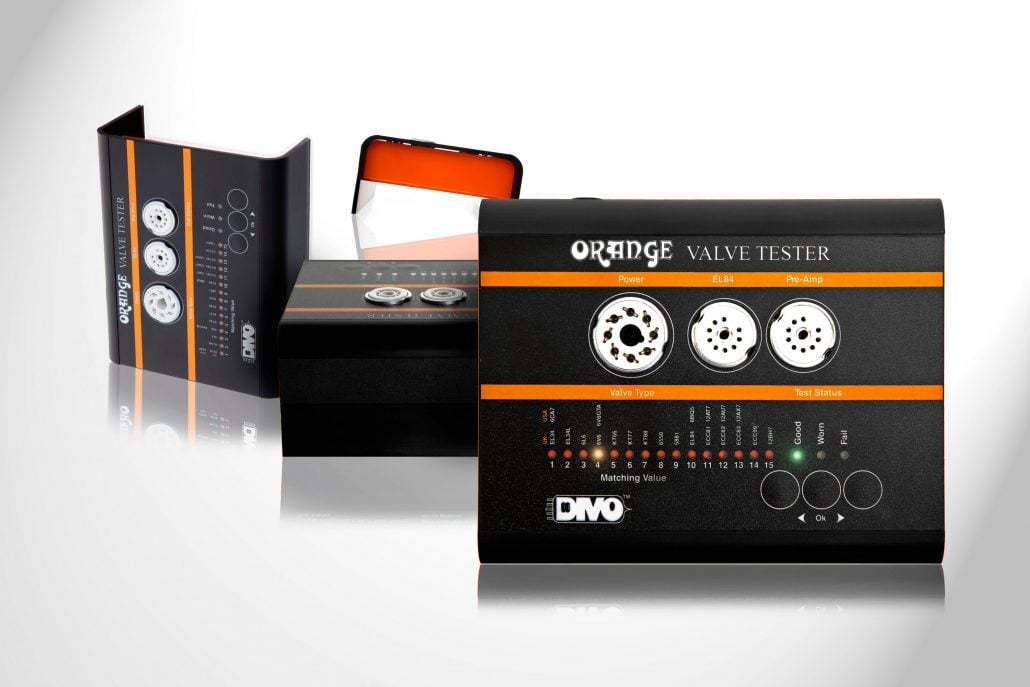
Orange Amplification are proud to launch a pioneering new technology to match, test and grade valves – the Orange DIVO VT1000 Valve Tester. This ground breaking new product will help every guitarist, rental company, valve amp manufacturer, guitar tech and guitar / hi-fi store across the planet.
The compact and extremely easy to use VT1000 is a fully automatic valve tester, which performs a wide range of tests quickly and accurately. The benefits of using the VT1000 are clear and wide reaching; users can quickly and simply match and test valves, plus receive a reliable health check as to whether their valves are good, bad or worn.
Orange Amps developed the world’s first fully automatic, portable, digital valve tester, the VT1000, to make it easy to test amp valves. Until now testing valves with little or no knowledge of valve theory was difficult, expensive and often unreliable. This new product will test all popular power and pre-amp valves. Its ease of use will appeal to all valve users whether amateur, professional or in the music retail trade.
The unit has one octal and two nine pin valve sockets for different valve types; simply insert the valve to be tested into the correct socket, select the valve type from the list on the unit and press ‘OK’ to test. The results are displayed clearly and concisely using LEDs and will test for a wide range of fault conditions, which could easily cause damage to other components. The simplicity of operation belies what is going on ‘inside the box’, where a CPU controlled testing system is in operation, allowing full control over all inter-electrode switching and measurement operations.
In approximately two minutes, the VT1000 performs an extensive series of tests including:
- Heater filament test: Short circuit
- Heater filament test: Open circuit
- Heater filament test: Tolerance check
- Heater cathode insulation: Leakage
- Heater cathode insulation: Short Circuit
- Tests for heater current abnormalities
- Amplification factor
- Voltage gain
- Power gain
- Screen grid test
- Mutual conductance test
- Dual test for double triodes
- Emission
- Inter electrode leakage
- Inter electrode short circuit
- Flash-over (arc detection, high voltage breakdown)
- Gas ionisation test
The VT1000 really opens the door to everyone to have an extremely simple, portable, reliable, inexpensive and safe way to test valves.
The VT1000 incorporates patent-pending technology and currently tests the following valves:
EL34/6CA7; EL34L; 6L6; 6V6/6v6GTA; KT66; KT77; KT88; 6550; 5881; EL84/6BQ5; ECC81/12AT7; ECC82/12AU7; ECC83/12AX7; ECC99; 12BH7
VT1000 Valve Tester FAQs.
Will any damage occur if a faulty valve is plugged in?Can I remove the valve immediately after the test completes?
If I re-test the same valve the readings are slightly different, is this ok?
The DC supply to the tester is only 19V; how can this test the valve properly?
Most valve testers do not use the voltages that are found in real amplifiers, is this one any different?
Can physically damaged valves be tested?
Can I use the VT1000 in different countries or do I have to order a special model?
Some faulty valves fail at different stages in the test, is this normal?
If I accidentally plug a double triode into the EL84 socket or vice versa, will any damage be caused either to the valve or to the VT1000?
I have noticed that on some valves the silver appearance on the glass has turned a milky white colour and is sometimes flaking. Does this signify a faulty valve and will there be any problem in testing it?
What tests does the VT1000 perform?
If I accidentally select the wrong valve type and start the test, will any damage be caused?
Sometimes new valves don’t give high matching numbers; does this mean that they are still OK?
Why do I need a valve tester when I can test old or suspect valves in an amplifier?
How does the Orange VT1000 differ from other commercially available valve testers?
• They require a certain level of user interaction in that parameters have to be set for individual valves being tested;
• They require a certain depth of knowledge about valve theory, which some users may not have;
• The results obtained on meters or digital readouts require a certain level of user interpretation;
• They are often quite large and bulky
In a lot of cases, they are also not very portable and since most are mains operated, require selection of mains voltage if required to be used in other than their native country.
When developing the VT1000 we decided to ‘break the mould’ to produce a fully automatic valve tester, which performs a wide range of tests quickly and accurately. Requiring little or no knowledge of valve theory, it can be operated by experienced users and those who just want to know that the valves in their amplifier are in good condition. It requires no user interaction other than inserting the valve to be tested into the correct socket, selecting the type from a list using two up/down buttons using an LED bar display, then finally pressing a ‘START’ test button.
The test then proceeds without any further user input and an elapsed time is displayed on the bar-graph display during the test, when one of three LED’s is lit to indicate a ‘PASS’, ‘WORN’ or ‘FAIL’ condition.
In addition, the LED bar-graph display indicates a ‘matching number’ which is based on a summation of the many results obtained during the test and has been specifically designed to reflect the operation of the valve, according to its normal function in an audio amplifier. For example, power valves are graded with their emission and control grid performance as primary factors, whereas pre-amp valves are graded with different parameters to reflect their role in signal amplification and phase splitting applications. If the valve is faulty or worn, then this will be indicated at the end of the test.
The simplicity of operation belies what is going on ‘inside the box’, where a sophisticated microprocessor controlled testing system is in operation, allowing full control over all inter-electrode switching and measurement operations. In addition all voltages required by the tester are internally derived, stabilized and controlled by the microcontroller, allowing us to perform static and transient tests rapidly and without generating unnecessary heat. The test algorithms used have been developed using data from tests on hundreds of new, used and faulty valves.
We are passionate about valve technology and our aim throughout has been to make the Orange VT1000 a sophisticated, modern, truly portable valve tester which is primarily useful but also stylish. We believe that it will appeal to all valve users whether amateur, professional or in the music retail trade.
How does the rating system relate to Gain in preamp and power amp valves. Higher rating = lower gain?
Matching power amp tubes: Of course, same rating tubes of the same brand can be used as a matched pair, but what if the rating is 1 or 2 points off. Is the use in the same amp safe? What's the max safe discrepancy? What if the matching is identical, but the brand is different?
At what voltage does the VT1000 test for flashover?
REVIEWS & AWARDS:
“Other companies will be looking with envy at Orange’s ground-breaking technology.” | 4 Stars | Guitar Interactive Magazine Issue 76
“The first and possibly only valve tester that anyone can use without any specialist knowledge.” | 4 Stars | Music Radar
“If your interest in valve amplifiers goes beyond merely playing through them, it’s a wonderful tool to have” | 91/100 | Guitar & Bass Magazine
“I think there will also be a large group of people who will think the VT1000 is one of the best things since sliced bread.” | Sonic State.com